

VCC's Modern Apprenticeship Pathway (MAP) — Construction Electrician
A new model to support apprentices and employers
Why rethink traditional apprenticeships
B.C.’s construction sector is projecting over 85,0001 job openings in the next decade. Apprenticeships are a proven solution, returning $1.42 for every $1 invested in Construction Electricians2. But many employers still face barriers – 32% can’t find apprentices, 24% cite supervision demands, and 23% lack steady work to support traditional block training.
How the MAP model removes apprenticeship barriers
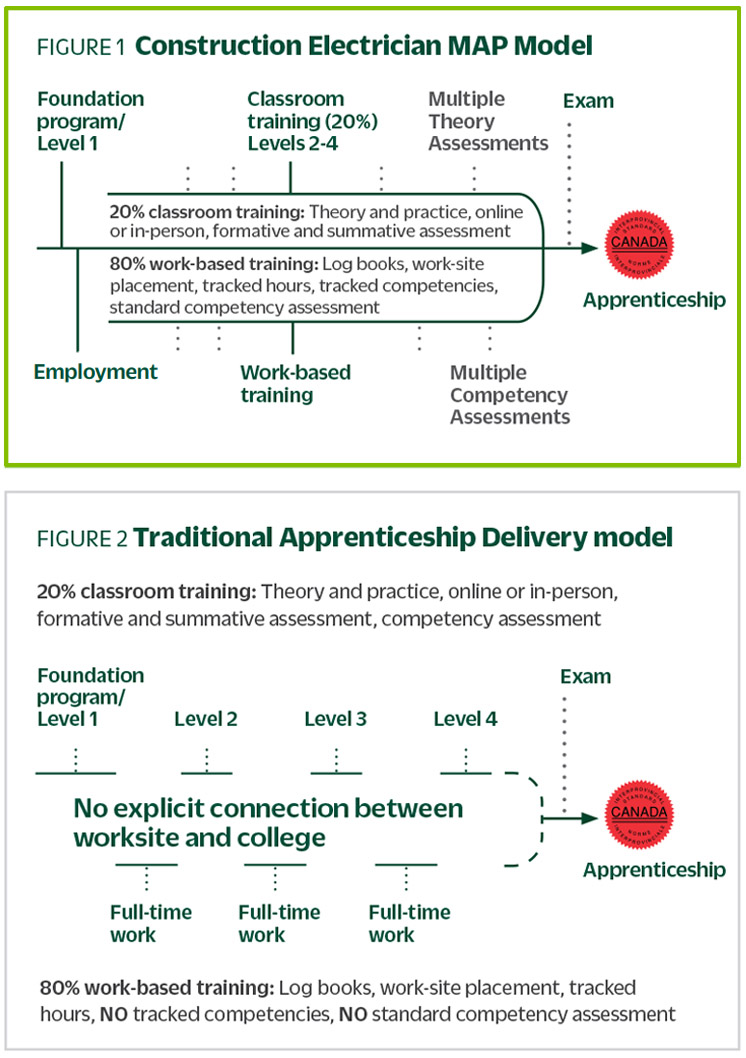
VCC’s MAP model removes these obstacles by integrating work and learning. Apprentices stay on the job while completing training through a flexible, blended model – including onsite competency assessments and continuous college support.
Key outcomes:
Integrated technical training and work-based learning
Stronger retention
Uninterrupted productivity
Pre-screened, job-ready candidates
Integrated Work-Based Learning
VCC’s MAP model (figure 1) blends the strengths of B.C.’s traditional SkilledTradesBC model (figure 2) with proven approaches – particularly Scotland’s Modern Apprenticeship program – to deliver a more flexible, work-integrated path to Red Seal certification that directly addresses current challenges in training and recruitment.
Key features of the MAP model
Apprentices remain employed while progressing toward Red Seal certification through:
- Integrated work and learning:
Maintains the 80/20 model – 80% on-the-job, 20% technical training – but fully integrated throughout the apprenticeship, not in blocks - Flexible, blended delivery:
Online and in-person options remove geographic and scheduling barriers - Ongoing competency assessments:
Skills are evaluated continuously, both on-site and in theory - Fast entry to employment for Construction Electricians:
6 months of foundational theory, then uninterrupted paid work - Faster progression:
Continual enrolment between technical training levels, integrated learning reinforces practical skills.
VCC’s Modernized Apprenticeship Pathway (MAP) model provides apprentices with:
- Job security
Continuous employment throughout training, strengthening workplace relationships and mentorship - Flexible learning
Study where you work with no geographic barriers, with scheduling options that align with industry demands - Faster progression
Continual enrolment between technical training levels, integrated learning reinforces practical skills.
- Keep workers on-site
No 8-10 week school block leaves – apprentices contribute continuously on projects - More flexibility
Class schedules adapt to project needs; option to include company-specific training - Improved retention
Build on a current 45% retention rate over 5 years, strengthened by ongoing engagement among apprentices, employers, and trainers - Stronger talent pipeline
Recruit from job-ready Foundation students, with early interviews to ensure the right fit - Easier supervision
Structured skill progression reduces pressure on journeypersons
- Offer student placements with on-site mentorship
- Provide flexibility for online or blended technical training
- Support ongoing competency assessments with a VCC instructor
- Fulfill standard SkilledTradesBC sponsorship requirements
Flexible funding models can be tailored to meet the needs of industry partners. VCC works collaboratively with employers to explore options that align with organizational capacity and workforce development goals.
Getting started is simple:
- Initial consultation to understand your workforce needs
- Customized pilot planning
- Mentor training with ongoing support
- Coordination of apprentice matching and recruitment
We look forward to working together to build the future of your workforce.
Contact us
Claire Sauvé
Project director, MAP project
Phone: 604.443.8679
Email: csauve@vcc.ca
1 BC LMO 2025-2035 - 28,100 expansion and 59,200 replacements