

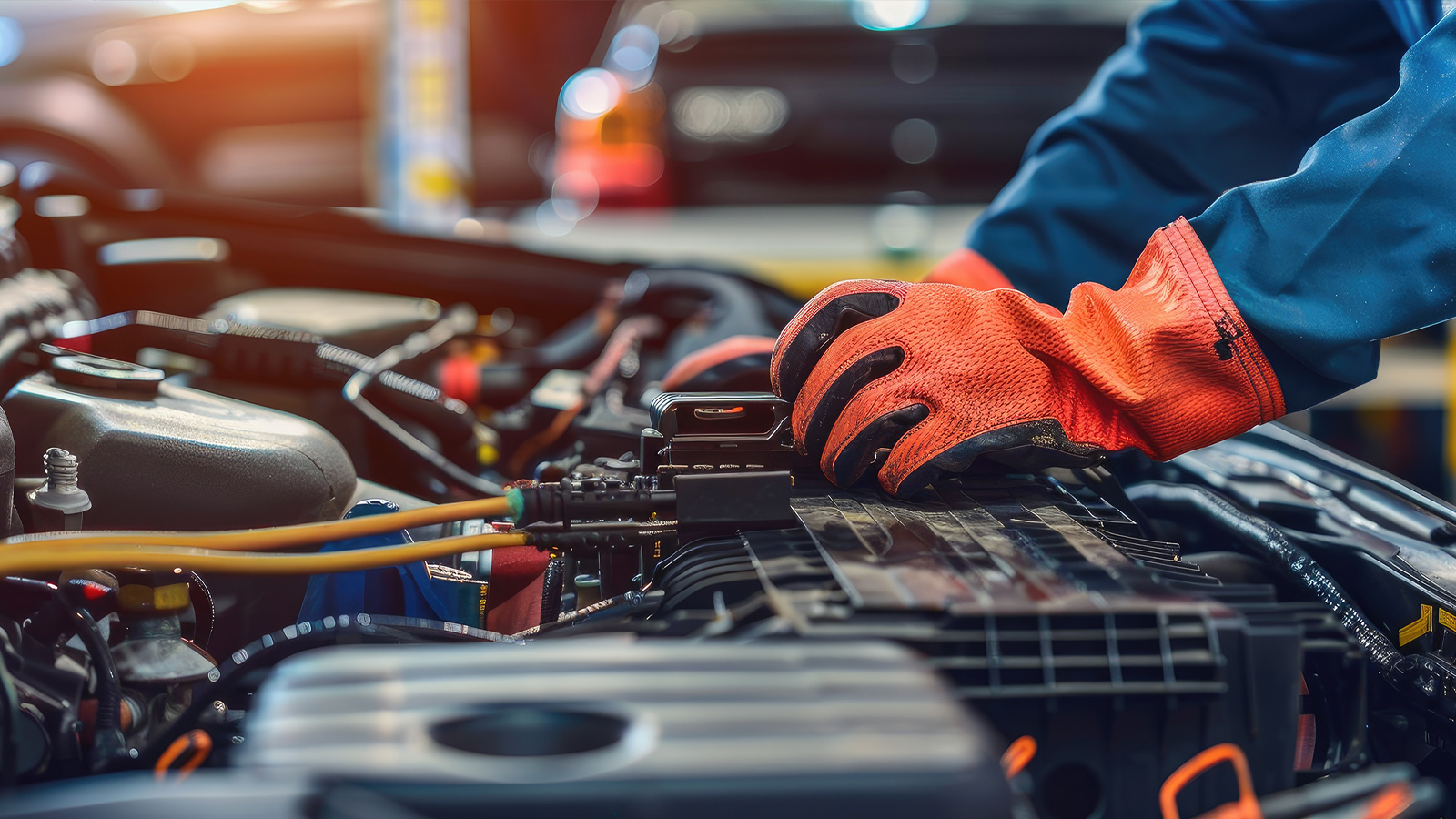
Build the skills to service today’s electric vehicles. Learn high-voltage battery repair, advanced diagnostics, and EV safety procedures. Prepare for entry-level roles in EV repair shops, dealerships, and automotive manufacturing
Automotive Electronics Repair

Info Week at VCC
Join us online or in-person for our info sessions, April 20-24.
What you will learn
Upon successful completion of this program, graduates will be able to:
- Diagnose and repair electronic systems in electrified vehicles at an entry-level
- Conduct safe servicing and reconditioning of high-voltage battery systems, drive electronics, and EV control components in accordance with industry protocols.
- Use electronic testing equipment and diagnostic tools to interpret data, identify faults, and verify completed repairs to meet manufacturer specifications.
- Adhere to high-voltage safety procedures, shop regulations, and environmental standards specific to electrified vehicle repair.
- Demonstrate professionalism, effective communication, and attention to detail in interactions with clients, coworkers, and supervisors during repair tasks.
- Collaborate effectively as a team member in technical service environments such as EV repair shops, dealership service departments, or manufacturing support facilities.
What to expect
Program Duration and Maximum Time for Completion
This is a one-year certificate program delivered over two academic terms. Students are expected to complete the program within one year of full-time study. The maximum time permitted for program completion is three years.
Instructional time is divided between classroom activities and practical workshop experiments.
Classroom activities consist of lectures, simulations, demonstrations, audio-visual presentations, and hands-on exercises that provide practical working knowledge of the concepts discussed. Extensive workshop experience is provided to reinforce theoretical concepts, develop hand skills, and build familiarity with diagnostic tools, high-voltage safety procedures, and electronic systems used in electrified vehicles.
During the first week of instruction, students will be given an orientation to the program, safety protocols, and the facilities of the College.
Admission requirements
Program-specific
- English 11 (Composition 11) with a minimum ‘C’ grade or equivalent
- Workplace Math 11 with a minimum ‘C’ grade or equivalent
- Physics 11 with a minimum ‘C’ grade or equivalent
OR
Departmental approval based on relevant experience
General
- This program is available to Canadian citizens and permanent residents. See program options for international students at VCC International.
- Applicants who self-identify as Indigenous are strongly encouraged to connect with VCC’s Indigenous Education and Community Engagement team to learn more about VCC’s Indigenous Enrolment policy, application preparation/completion, program advising, and a range of other individualized services.
- Applicants must be 16 years of age or older or a graduate of a secondary school. (Some exceptions may apply.)
- Applicants must submit official transcripts and other documents as required by their course or program. Seats are offered to eligible applicants with completed applications, in order of application completion date (except for programs with competitive admissions). A complete application includes an application form, evidence of educational pre-requisites (e.g. transcripts), any required supporting documents (e.g. language proficiency, audition video), and the required deposit or fee payment. If you do not meet the requirements for the term applied, your application may be cancelled.
Missing prerequisites? Learn more about VCC's tuition-free academic upgrading or English as a Second Language (ESL) courses, or discover which university transfer options are right for you.
Program Considerations
- Program tasks require use of materials or chemicals that may aggravate respiratory or skin conditions
- Program tasks require handling of equipment and materials that may be heavy
- Program environment includes exposure to noise and vibration in lab/workshop environments
- Program tasks require use of fine motor skills and coordination
- Program tasks require differentiating colors for wiring and detailed visual assessments in automotive and technical work
- Program tasks require depth perception for precision work
Courses *
Prior learning assessment and recognition
Students may request formal recognition of prior learning attained through informal education, work, or other life experience, including Indigenous ways of knowing. Credits may be granted to students who are able to sufficiently demonstrate the learning outcomes of specific courses.
Students may complete up to twelve (12) credits through PLAR and/or transfer credit. Tuition and fees will still apply.
-
Methods of assessment will include: Actual service records, technical documents, diagnostic logs, or artifacts created and used by the applicant in their workplace which are judged equivalent to the curriculum documents required in the course assignments.
-
An essay in which the applicant describes the development of their technical thinking and professional practice in relation to the themes, issues, and concepts of the course (e.g., safety, diagnostics, repair processes, and system integration).
-
A successful interview with the department to confirm applied knowledge and safety practices.
-
If PLAR is successful, transcripts will reflect an 'S' grade (satisfactorily completed), which is not included in grade point average (GPA) calculations.
See Policy 316 Prior Learning Assessment and Recognition for more information.
| Code | Title | Credits |
|---|---|---|
| ELRT 1001 | Alternating Current (AC) Basics | 3 |
| ELRT 1002 | Direct Current (DC) Circuit Analysis | 3 |
| ELRT 1003 | Power Supply Fundamentals | 3 |
| ELRT 1004 | Technical Skills 1 | 5 |
| ELRT 1005 | Introduction to Lean Six Sigma | 1 |
| ELRT 1110 | Automotive Electronic Control Module Repair | 3 |
| ELRT 1120 | Python Programming for Automotive Repair | 3 |
| ELRT 1130 | EV Electronics Lab | 3 |
| ELRT 1140 | Electric Vehicle Motor Rebuilding | 3 |
| ELRT 1150 | Automotive High Voltage Battery Repair | 3 |
| Total Credits | 30 | |
* This information is intended as a guideline only. Program and course details are subject to change with the approval of VCC's Board of Governors.

Fees and other costs *
| Fee description | Fee Amount | Notes |
|---|---|---|
| Application fee | 36 | |
| Tuition Tuition | 11453 | |
| Student union | 145 | |
| College initiative | 90 | |
| Materials | 0 | not including textbooks |
| Campus resource | 229 | |
| Laundry | 0 | |
| Tools (deposit) | 0 | |
| Coverall (deposit) | 0 | |
| Uniform (deposit) | 0 | |
| Medical and Dental | 285 | |
| Temporary Medical Insurance | 0 | |
| U-PASS | 376 | |
| Graduation | 45 | |
| Program-specific extra fees | 0 | |
| Total |
* Fees are approximate and subject to change with the approval of VCC's Board of Governors. Students are required to pay any applicable fee increases. Application and assessment fees are non-refundable. Tuition fees include a non-refundable deposit ($300 or $500, depending on program).
Fees listed are for domestic students. For international programs, visit VCC International.
Any refunds are issued according to VCC's refund policy.
Apply now
Get started
Info Week at VCC
Join us online or in-person for our info sessions, April 20-24.