

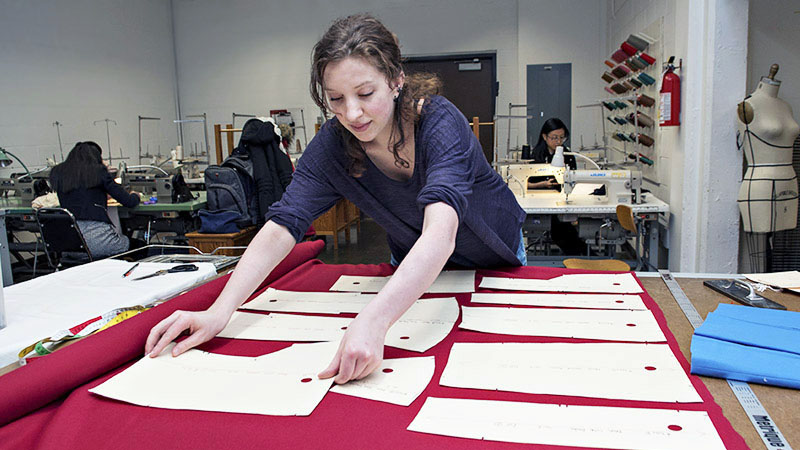
Expand your creative and technical skills for the fashion and apparel industry by gaining hands-on experience in conception, design, production, sales, and more. Part-time and full-time options offer flexibility in completing the certificate and diploma programs.
Fashion Design and Production

Info Week at VCC
Join us online or in-person for our info sessions, April 20-24.
What you will learn
Upon successful completion of this program, graduates will be able to:
- Draft patterns with an eye to fit and function
- Plan and execute garment construction using professional industry-standard techniques and equipment
- Develop and express a creative vision in design
- Strategize and problem-solve the full cycle of fashion production, given a variety of contexts
- Examine, critique and re-imagine fashion industry practices and norms
- Collaborate effectively with diverse teams across the fashion industry
What to expect
Program Duration and Maximum Time for Completion
The Fashion Design & Production Diploma Program can be completed in 2 years, maximum duration for completion is 5 years. The program is designed for flexibility allowing students to complete it in a variety of part time and full time options.
Students may choose to exit the program and receive a Certificate credential upon completion of all first-year courses (20 courses, 36.5 credits) and FSHN 2321 Work Experience for Fashion Design.
To achieve the Fashion Design & Production Diploma, students must successfully complete all first- and second-year courses (28 courses, 60.5 credits) which includes FSHN 2321 Work Experience for Fashion Design.
The Fashion Design & Production Diploma curriculum is designed to provide context and mimic the real-world fashion industry.
Courses are delivered through a combination of instructional activities including, but not limited to, interactive lectures, practical labs, demonstrations, guest speakers, videos, team activities, production simulations, computer labs, field trips, and work experience. To support the development of motivation and self-discipline, some of the theoretical and technical aspects of the program involve independent learning components.
The Fashion Design and Production program is committed to the following embedded values:
1. Respect Others
- Creating inclusive learning experiences that accommodate diverse learning styles and needs, ensuring accessibility for all students.
- Recognizing and integrating Indigenous ways of knowing and being in the curriculum, as a step towards truth and reconciliation.
- Being mindful of biases in all forms. Striving to create an equitable and inclusive environment by challenging stereotypes and promoting diverse perspectives.
- Co-creating a supportive and respectful learning space that encourages mutual respect, accountability, and a sense of belonging
2. Honour Earth
- Empowering the next generation of merchandisers with the skills to consider environmental impacts and an attitude that is waste conscious, respects the entire lifecycle of a product, and knows the importance of mindful consumption and production.
- Valuing relationship building with the more than human world and selling clothing that considers future generations.
3. Value Self
- Becoming who you are meant to be as a merchandiser; allowing full expression of personal style, tastes, and preferences.
- Being conscious and aware of our own thoughts and feelings, without judging, and staying open to new experiences.
- Working mindfully with an appreciation of the deep connection between your vision, the energy of the materials, the hands that make the clothes, and the spirit of the wearer.
- Celebrating and honouring your cultural identity, and the history of making in your life, family or heritage.
Students and instructors are expected to strive toward these values.
Admission requirements
Program-specific
Admission to this program is through a competitive selection process.
- Grade 12 graduation, or equivalent
- English 12 with a mininum 'C' grade, or equivalent
- Letter of Intent (500 words or fewer)
- Portfolio:
- Two pieces of original artwork
- Sketch book including a minimum of 20 fashion-related drawings
- Two sewn items
- Interview with Program Coordinator
General
- Seats are offered to applicants who have met all admission requirements, on a first-qualified, first-served basis.
- International applicants must be 17 years of age or older or a graduate of a secondary school. (Some exceptions may apply.)
- Applicants must submit official transcripts and educational documents as required by their course or program.
- All VCC applicants are required to function successfully in an English-speaking classroom. English requirements vary by program. For details, visit VCC International - English Requirements.
Program Considerations
-
Program activities involve extended periods in fixed positions and repetitive hand, wrist, and arm movements, such as assembling or using specialized tools.
-
Program tasks require precise hand-eye coordination and dexterity. Activities may include detailed assembly, intricate cutting or decorating, and small-scale technical work requiring steady hand movements.
-
Program environment includes regular exposure to industrial grade machinery that may be loud, may vibrate and give off heat.
-
With appropriate safety protocols, the program environment may involve exposure to chemical products and strong odors. Students may also work with solvents and adhesives used in sewing and surface design environments.
-
Program environment involves regular exposure to airborne fabric particles.
-
Program involves physical contact with models during fittings.
-
Program tasks may involve high-pressure situations requiring quick decision-making, time-sensitive task completion, and sustained focus such as a photo shoot and fashion show.
-
Some elements of the program are self-paced, requiring students to manage their own study schedule and assignment completion.
-
Program tasks require access to a modern computer capable of running Microsoft Windows with full privileges. Required hardware consists of at least a quad-core processor and 16GB of RAM and 256GB storage, in order to complete assignments or connect to the lab computers remotely.
-
Online courses require audio/video hardware including webcam, speakers and microphone
Courses *
This program can be completed in two to three years.
Prior learning assessment and recognition
Students may request formal recognition of prior learning attained through informal education, work, or other life experience, including Indigenous ways of knowing. Credits may be granted to students who are able to sufficiently demonstrate the learning outcomes of specific courses.
PLAR is available for some courses in this program and will be assessed by the Department according to standardized practice and using one or more of the following components: project, professional portfolio, demonstration, and/or interview.
See Course Outlines for availability.
PLAR fees for every course apply without exception.
Students may complete up to 50% of program credits through PLAR and/or transfer credit.
See Prior Learning Assessment and Recognition policy for more information.
| First Year | Credits | |
|---|---|---|
| FSHN 1101 | Fashion Cycle 1 | 1.5 |
| FSHN 1103 | Fashion Cycle 2 | 1.5 |
| FSHN 1107 | Illustration and Design 1 | 2 |
| FSHN 1109 | Pattern Drafting 1 | 2 |
| FSHN 1111 | Sewing Techniques 1 | 2 |
| FSHN 1313 | Fabric and Textile Studies | 2 |
| FSHN 1215 | Tech Fashion Illustration 1 | 1.5 |
| FSHN 1201 | Fashion Cycle 3 | 1.5 |
| FSHN 1203 | Fashion Cycle 4 | 1.5 |
| FSHN 1115 | Fashion Portfolio 1 | 1 |
| FSHN 1207 | Illustration and Design 2 | 2 |
| FSHN 1209 | Pattern Drafting 2 | 2 |
| FSHN 1211 | Sewing Techniques 2 | 2 |
| FSHN 1315 | Tech Fashion Illustration 2 | 3 |
| FSHN 1301 | Fashion Cycle 5 | 3 |
| FSHN 1309 | Introduction to Pattern Grading | 1 |
| FSHN 1205 | Fashion History | 1.5 |
| FSHN 1317 | Fashion Exploration | 2 |
| FSHN 1319 | Textile Surface Design | 2 |
| Credits | 35 | |
| Second Year | ||
| FSHN 2117 | Project Final 1 | 6.5 |
| FSHN 1113 | Draping | 2 |
| FSHN 2109 | Computer Aided Drafting | 2 |
| FSHN 2315 | Fashion Portfolio 2 | 1.5 |
| FSHN 2217 | Project Final 2 | 6 |
| FSHN 2309 | 3D Pattern Making | 1.5 |
| FSHN 2205 | Overseas Production | 1.5 |
| FSHN 2320 | Business of Fashion | 1.5 |
| FSHN 2321 | Work Experience for Fashion Design | 4.5 |
| Credits | 27 | |
| Total Credits | 62 | |
* This information is intended as a guideline only. Program and course details are subject to change with the approval of VCC's Board of Governors.

Fees and other costs *
Tuition deposits are payable usually within three weeks after a Letter of Offer is issued.
| Fee description | Fee Amount | Notes |
|---|---|---|
| Application fee | 145 | |
| Tuition Tuition | 37370 | |
| Student union | 434 | |
| College initiative | 159 | |
| Materials | 555 | not including textbooks |
| Campus resource | 374 | |
| Laundry | 0 | |
| Tools (deposit) | 0 | |
| Coverall (deposit) | 0 | |
| Uniform (deposit) | 0 | |
| Medical and Dental | 570 | |
| Temporary Medical Insurance | 149 | |
| U-PASS | 1126 | |
| Graduation | 45 | |
| Program-specific extra fees | 0 | |
| Total |
* Tuition and other fees are approximate and subject to increase up to 5% per year. Students will be required to pay increased rates if the fees change at any time during the period of enrolment in the program. Application and assessment fees are non-refundable.
Fees listed are for international students. For domestic programs, visit vcc.ca.
Any refunds are issued according to VCC's international refund policy.
Apply now
Info Week at VCC
Join us online or in-person for our info sessions, April 20-24.