
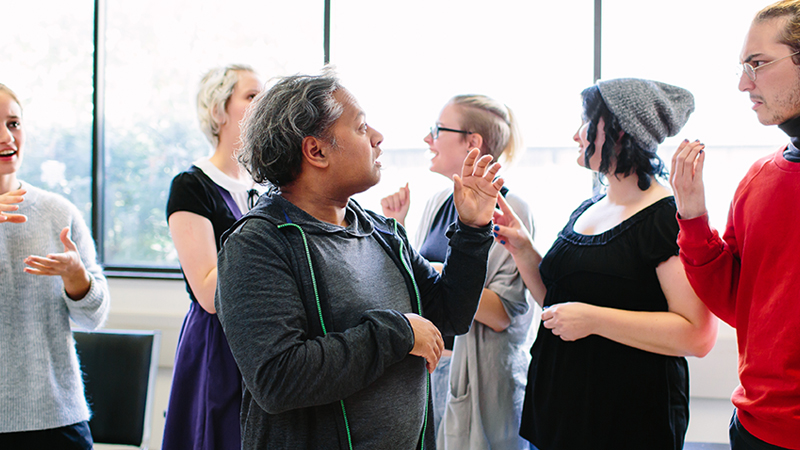
Learn to become a sign language interpreter. Facilitate the communication between hearing and Deaf and hard of hearing communities using American Sign Language (ASL).
Sign Language Interpretation

Info Week at VCC
Join us online or in-person for our info sessions, April 20-24.
What you will learn
Upon successful completion of this program, graduates will be able to:
- Construct and convey meaning via the interpreting process by applying comprehensive linguistic, cultural, and functional analysis in various communication settings.
- Effectively monitor, assess and critique the quality of an interpretation, engaging with feedback and adjusting as needed.
- Make appropriate decisions regarding the use of simultaneous and/or consecutive interpreting modes and the use of interaction management strategies.
- Demonstrate fluency and versatility in American Sign Language across different topics, registers, and communication settings.
- Comprehend and effectively produce spoken and written English within a variety of contexts and types of discourse.
- Interact respectfully within the Deaf and Deaf-Blind communities, exhibiting cultural competence, reciprocity, and an understanding of Deaf identities and organizations.
- Demonstrate allyship and an awareness of positionality, power, and the systemic effects of audism.
- Use effective strategies and apply an awareness of self to managing stress and maintaining wellness.
- Demonstrate professionalism, teamwork, and effective communication in diverse interpreting contexts, adhering to standards in the field.
- Apply ethical principles, professional guidelines, and critical thinking to uphold integrity and accountability in interpreting practice.
- Engage in ongoing professional development, reflective practice, and active contribution to the interpreting community of practice.
What to expect
Program Duration and Maximum Time for Completion
The program is taught full-time over two years. The maximum time for completion is five years.
This program provides high quality instruction, unique curriculum and varied learning activities. Key features of the program include Deaf community involvement and one full term of practicum. Students are required to complete volunteer hours, immersion activities in the Deaf community (for example, camps lasting several days) and supervised work placements.
Course topics in the program include interpreting theory and practice, advanced ASL, service learning, allyship and positionality, Deafhood, professional ethics and standards of practice, among others.
In summary, the interpreting program consists of the following:
Year One:
- Fall term with full course load plus service learning in the community.
- Winter term with full course load plus volunteer interpreting in the community.
- Summer term (May & June) includes two courses plus continued community involvement.
Year Two:
- Fall term with full course load plus volunteer interpreting in the community.
- Winter/spring term (Jan to May) including three 4-week practicum placements. Travel and accommodation are at the student’s expense. At least one placement will be outside the Lower Mainland.
- Capstone week – submission of portfolio and demonstrations of readiness to graduate.
Admission requirements
Program-specific
Admission to the Sign Language Interpretation Diploma program is through a competitive selection process. Throughout the selection process, applicants are assessed for proficiency in American Sign Language (ASL) and English, an understanding of the Deaf community, Deaf culture, the field of Sign Language interpreting, and knowledge of social justice issues.
Admission Requirements
- ENGL 1100 with a minimum ‘B’ grade or equivalent
- ASLD 1215 or equivalent, or department permission
- INTR 1000 or equivalent, or department permission
- An ASL and Deaf Studies Certificate or equivalent, or department permission
- Submission of a CASPer score. CASPer test scores are valid for one admission cycle.
- Successful ASL panel interview including a faculty member, Deaf community member, and professional interpreter
Upon Acceptance to the Program
- Criminal Record Check
Students in this program are required to complete a CRC. The CRC must be completed according to VCC's Criminal Record Check instructions. Students whose CRC results indicate they pose a risk to vulnerable populations will not be able to complete the requirements of the program (e.g. practicums) or graduate.
General
- Seats are offered to applicants who have met all admission requirements, on a first-qualified, first-served basis.
- International applicants must be 17 years of age or older or a graduate of a secondary school. (Some exceptions may apply.)
- Applicants must submit official transcripts and educational documents as required by their course or program.
- All VCC applicants are required to function successfully in an English-speaking classroom. English requirements vary by program. For details, visit VCC International - English Requirements.
Program Considerations
- Off-campus learning environments may require navigating narrow and/or multi-level spaces to establish sightlines necessary to observe and/or use a visual language. Some activities may require navigating outdoor settings covering extended distances over several hours. Practicum courses can require early morning, evening or weekend shifts. Travel to different locations/outside the Lower Mainland is required for at least one practicum placement.
- Program activities involve continuous, repetitive hand, wrist and arm movement and movement of the facial muscles, head and neck in coordination with eye gaze.
- Some learning environments may include bright lights and loud, overlapping noises. Key learning activities require sustained auditory, visual, and cognitive focus in a broad range of novel environments.
- Program learning activities require students to engage in ongoing critical self-reflection and class discussion of topics that may be sensitive.
- Student interpreting activities require students to adapt their interpersonal communication approach and language to meet the needs of a wide range of diverse interlocutors. They may be required to interpret ideas and use of language they do not personally agree with.
- Program activities regularly require demonstrating emerging practical skills in front of classmates and/or community members in English and ASL.
- Program tasks often involve quick decision making, rapid processing of written English, auditory and visual linguistic and contextual information and time-sensitive task completion.
- Most courses require access to a laptop with audio/video hardware including webcam, speaker and microphone during class. The VCC library offers laptops on loan.
Courses *
Prior learning assessment and recognition
Students may request formal recognition of prior learning attained through informal education, work, or other life experience, including Indigenous ways of knowing. Credits may be granted to students who are able to sufficiently demonstrate the learning outcomes of specific courses.
PLAR is available for the following courses:
- ??INTR 3140 Interpretation Theory and Practice 4
- INTR 3150 Advanced American Sign Language for Interpreters
Methods of PLAR vary by course, and may include exams, professional portfolios, interviews, performance assessments, and other evaluations.
If PLAR is successful, transcripts will reflect an 'S' grade (satisfactorily completed), which is not included in grade point average (GPA) calculations.
See Policy 316 Prior Learning Assessment and Recognition for more information.
| First Year | Credits | |
|---|---|---|
| INTR 2100 | Positionality in the Deaf Community | 2.5 |
| INTR 2120 | Foundations of Practice 1 | 3 |
| INTR 2140 | Interpretation Theory and Practice 1: Translation | 3 |
| INTR 2150 | Deaf Community Service Learning 1 | 2.5 |
| ASLD 2180 | American Sign Language Level 8 | 3 |
| INTR 2210 | Ethics & Professional Decision Making | 2.5 |
| INTR 2220 | Foundations of Practice 2 | 2 |
| INTR 2240 | Interpretation Theory and Practice 2 | 3 |
| INTR 2250 | Deaf Community Service Learning 2 | 2.5 |
| INTR 2260 | Deafhood: Pathways to Identity & Diversity | 2.5 |
| ASLD 2290 | American Sign Language Level 9 | 3 |
| INTR 2340 | Interpretation Theory and Practice 3: Community | 3 |
| ASLD 2310 | American Sign Language Level 10 | 3 |
| Credits | 35.5 | |
| Second Year | ||
| INTR 3110 | Self and Community of Practice | 3 |
| INTR 3120 | Sign Language Interpretation in Educational Settings | 3 |
| INTR 3140 | Interpretation Theory and Practice 4 | 5 |
| INTR 3150 | Advanced American Sign Language for Interpreters | 3 |
| INTR 3210 | Sign Language Interpreting Practicum Readiness | 1.5 |
| INTR 3220 | Sign Language Interpreting Practicum 1 | 4.5 |
| INTR 3230 | Sign Language Interpreting Practicum 2 | 4.5 |
| Credits | 24.5 | |
| Total Credits | 60 | |
* This information is intended as a guideline only. Program and course details are subject to change with the approval of VCC's Board of Governors.

Fees and other costs *
Tuition deposits are payable usually within three weeks after a Letter of Offer is issued.
| Fee description | Fee Amount | Notes |
|---|---|---|
| Application fee | 145 | |
| Tuition Tuition | 38657 | |
| Student union | 362 | |
| College initiative | 190 | |
| Materials | 0 | not including textbooks |
| Campus resource | 387 | |
| Laundry | 0 | |
| Tools (deposit) | 0 | |
| Coverall (deposit) | 0 | |
| Uniform (deposit) | 0 | |
| Medical and Dental | 570 | |
| Temporary Medical Insurance | 149 | |
| U-PASS | 892 | |
| Graduation | 45 | |
| Program-specific extra fees | 0 | |
| Total |
* Tuition and other fees are approximate and subject to increase up to 5% per year. Students will be required to pay increased rates if the fees change at any time during the period of enrolment in the program. Application and assessment fees are non-refundable.
Fees listed are for international students. For domestic programs, visit vcc.ca.
Any refunds are issued according to VCC's international refund policy.
Apply now
Interview and Video Submission: See the Sign Language Interpretation Diploma Program Interview & Video Submission Guidelines for important information.
How to apply:
STEP 1: Start your application
- Apply online at EducationPlanner BC
- Submit your one-page letter of intent
- Remember to submit your official transcripts
STEP 2: Complete the CASPer assessment
- Register for one of the following dates on the CASPer website
- Nov 30, 2025 - 1:00 PM PST
- Dec 2, 2025 - 5:00 PM PST
- Jan 8, 2026 - 5:00 PM PST
- Jan 22, 2026 - 5:00 PM PST
- Feb 19, 2026 - 5:00 PM PST
- Mar 5, 2026 - 5:00 PM PST
- Apr 9, 2026 - 5:00 PM PDT
STEP 3: Check your email regularly
- Your application documents will be reviewed by the selection committee.
- If you are selected, you will receive an email to attend an online interview.
- If you are not selected, you will receive an email informing you of the decision and your application ends here.
STEP 4: Participate in online interview
You will be invited to interview on one of the following dates:
- April 29, 2025
- April 30, 2025
- May 1, 2025
STEP 5: Meet the Faculty Event
- May 2, 2025: Attendance is optional but strongly encouraged. This is an opportunity to engage with a professional interpreter panel and a current interpreting student panel, meet the program faculty and staff, and learn more about the program. Interpretation will be available.
STEP 6: Check your email regularly
- After all interviews are complete, you will be notified of your standing by email.
- If you are accepted, the Admissions Office will contact you within two weeks with information about fees and deadlines.
- If you are not accepted, you will receive an email informing you of the decision.
Info Week at VCC
Join us online or in-person for our info sessions, April 20-24.